 Anti Microbial Resistance Marker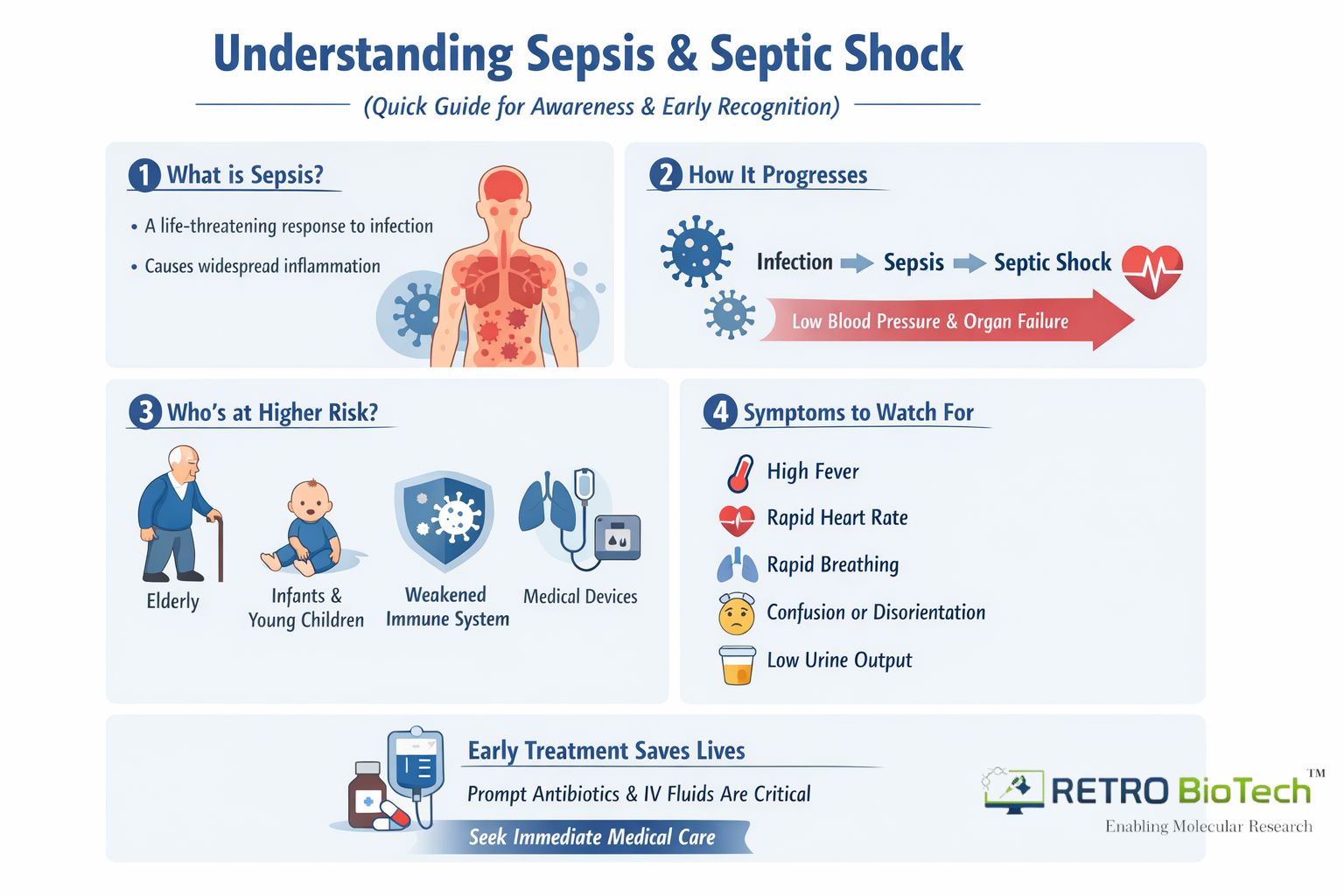
Sepsis & Septic Shock: Why Rapid Molecular Detection Is Critical for Saving Lives
Sepsis is a life-threatening medical emergency caused by the body’s overwhelming and dysregulated response to infection. When not identified and treated early, sepsis can rapidly progress to septic shock, multi-organ failure, and death. Globally, sepsis remains one of the leading causes of mortality in intensive care units—particularly in neonates, immunocompromised patients, and critically ill adults.
At Retro Biotech, we believe that early, accurate, and comprehensive pathogen detection is central to improving sepsis outcomes and strengthening antimicrobial stewardship through advanced molecular diagnostics.
What Is Sepsis?
Sepsis occurs when an infection triggers a systemic inflammatory response, leading to tissue damage, impaired blood flow, and organ dysfunction. Common sources include:
-
Bloodstream infections
-
Pneumonia
-
Urinary tract infections
-
Abdominal and soft tissue infections
Without rapid intervention, sepsis can escalate to septic shock, characterized by persistent hypotension, lactic acidosis, and organ failure.
Why Early Diagnosis Matters in Sepsis
Traditional blood culture–based diagnostics, while considered a reference method, have well-recognized limitations:
-
Long turnaround time (24–72 hours or more)
-
Reduced sensitivity due to prior antibiotic exposure
-
Limited ability to rapidly detect polymicrobial infections
-
No early insight into antimicrobial resistance (AMR) mechanisms
In contrast, multiplex real-time PCR (qPCR) enables simultaneous detection of multiple pathogens and resistance markers within ~60 minutes, supporting early clinical decision-making and targeted therapy.
Retro Biotech’s Molecular Approach to Sepsis Detection
Retro Biotech has developed advanced multiplex qPCR panels for sepsis research and surveillance workflows. These assays are designed to provide broad microbial coverage, AMR insight, and workflow efficiency for modern laboratories.
Sepsis and AMR Detection Kit (RUO)
The Sepsis and AMR Detection Kit (RUO) is a high-plex, open-system real-time PCR assay designed for research-based detection of bloodstream infection–associated pathogens and antimicrobial resistance markers.
Key Features
-
Detection coverage:
-
17 bacterial pathogens
-
3 fungal pathogens
-
11 antimicrobial resistance genes
-
-
8 multiplex reaction mixes with four dye channels (FAM, SUN, Cy5, TxRed)
-
Integrated Exogenous Extraction Control (EEC) to monitor extraction and PCR performance
-
Designed for polymicrobial sepsis profiling
-
Compatible with major open qPCR platforms (Bio-Rad CFX96/384, Applied Biosystems QuantStudio, ABI 7500 Fast Dx)
-
Estimated run time: ~60 minutes
This panel supports research applications involving pathogen surveillance, AMR profiling, and molecular epidemiology of sepsis, enabling faster insights compared to conventional methods.
Advantages of Multiplex qPCR in Sepsis Research
-
Speed: Results within hours instead of days
-
Breadth: Simultaneous detection of bacteria, fungi, and AMR genes
-
Sensitivity: Effective even with low microbial load
-
Stewardship support: Early AMR insight reduces empirical broad-spectrum antibiotic use
-
Scalability: Suitable for high-throughput and surveillance studies
Applications Across Healthcare & Research Settings
-
Hospital-based sepsis research programs
-
AMR surveillance and epidemiological studies
-
ICU and NICU infection profiling
-
Evaluation of rapid diagnostic workflows
-
Comparative studies versus culture-based methods
Commitment to Simplified Molecular Diagnostics
At Retro Biotech, our mission is to make complex molecular testing simpler, faster, and more accessible. Our sepsis panels reflect this philosophy by combining robust assay design, multiplex efficiency, and open-platform compatibility, supporting laboratories as they move toward rapid, actionable molecular insights.
Early detection saves lives. Molecular precision guides therapy.